
ANICOM project team is going into the field!
The research project Animal Communicators: Intuitive communication as a key to dialogic multispecies methods, (ANICOM) has started September 2024 for a period of five years at the University of Liège Laboratory of Social and Cultural Anthropology (LASC). After a three-day multispecies methods workshop in which the project was introduced to the advisory board and the wider public, ANICOM is now starting its fieldwork phase, with the team preparing to travel to 9 different locations.

The project sets out to collaborate with animal communicators and wild as well as domesticated animals from 12 species across Europe, Africa, Asia, and North America, aiming to explore IIC in order to foster deeper cooperation and understanding between humans and animals. The research team consists of scholars with roots on four continents, from scholarly fields that include social and cultural anthropology, environmental governance, health studies and biology, who have started work February 2025.
A four minute video to introduce the project can be found here, while more information on the logo and the project rationale can be found on the dedicated ANICOM website.
Podcast Animals & Us: Voices of a new paradigm
Animals & Us is a series exploring nature sentience, consciousness and communication. In this rather personal podcast I am interviewed by researcher Avantika Mathur-Balendra and veterinarian and animal communicator Dr. Barbara Shor, regarding my journey into ethnography, filmmaking, IIC and the upcoming ERC project ANICOM.


The European Union has selected my project Animal Communicators: Intuitive communication as a key to dialogic multispecies methods (ANICOM) for a 2023 ERC Consolidator grant.
The project will commence September 2024 at the University of Liège Laboratory of Social and Cultural Anthropology (LASC). It has a duration of 5 years and involve fieldwork on four continents, the team including myself and a postdoc, 3 PhD students (see call), 8 animal communicators and 36 individuals from 12 animal species.
Abstract: As the ‘social’ in social sciences is rethought beyond the human, multispecies research across disciplines increasingly asks how to speak with and for non-human others. I pose that intuitive interspecies communication (IIC), a strategy practiced by successful animal communicators to engage in explicit, detailed, two-way communication with non-human animals, holds uncharted resources for doing research with rather than on animals.
Research on IIC has been curtailed to specific domains and mythologized, while the worldwide boom in professional animal communicators has been ignored. ANICOM’s unique engagement with animal communicators’ practical strategies for relating across nature/culture and mind/body dichotomies is ground-breaking in the often largely theoretical discussions of the ontological and species turns. It simultaneously unsettles continued divides between humans and animals as well as dominant and subjugated ways of knowing.
The project triangulates participant observation, Q method, interviews and audio-visual methods (including video-diaries and video-elicitations) with natural science approaches, to collaboratively work with six expert animal communicators and a variety of animals in Europe and Africa. It addresses unexplored possibilities for cross-fertilization between new materialism and posthumanism on the one hand, and Indigenous studies and knowledge systems on the other, while relying on the latest insights in biosemiotics and animal cognition. It thus develops transdisciplinary innovations that include non-human animals as full research participants, while achieving a deeper reflexivity on the limitations of humans thinking animals outside the human-animal relationship.
It’s ultimate objective is to establish the resources and foundation for dialogic multispecies methods (DMM), a dynamic set of conceptual, theoretical and methodological approaches and tools to engage with the views, experiences and knowledges of non-human animals in academia.

Buy an ebook (including free access to internationally screened documentaries) to support the local Maasai with food
Kaufen Sie das E-Book (mit kostenlose Zugang zu Dokumentarfilme), um die lokalen assai mit Lebensmitteln zu unterstützen
The Maasai community in Tanzania was hit hard by the pandemic, as tourism effectively halted. More and more families have no food anymore at all. For 22 Euro a household can buy a bag of maize to cook a very simple porridge for one month. For 87 Euros the local school can provide the children of the village with one simple but nutritious meal per day for one week. Every book sold and any further donations will directly and fully reach the affected Maasai community.
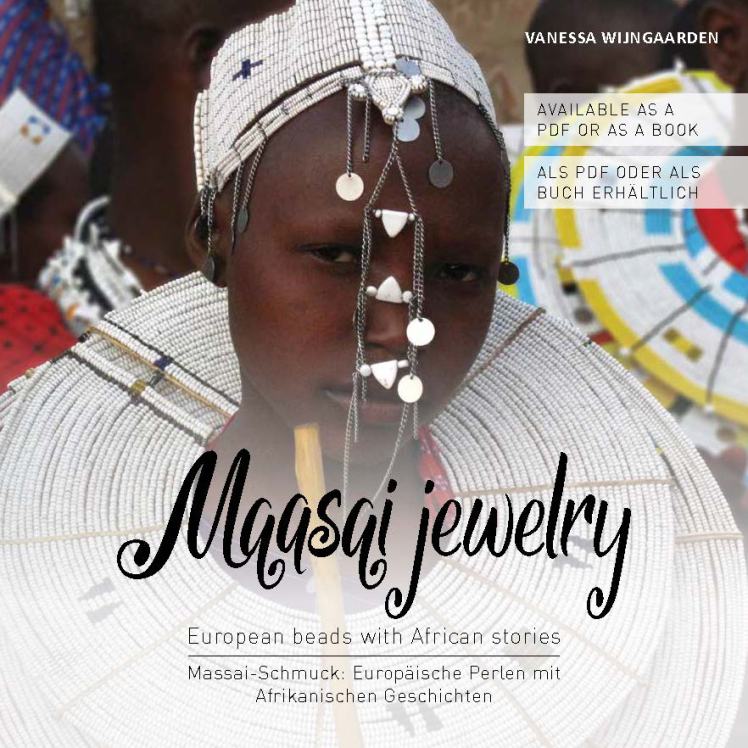
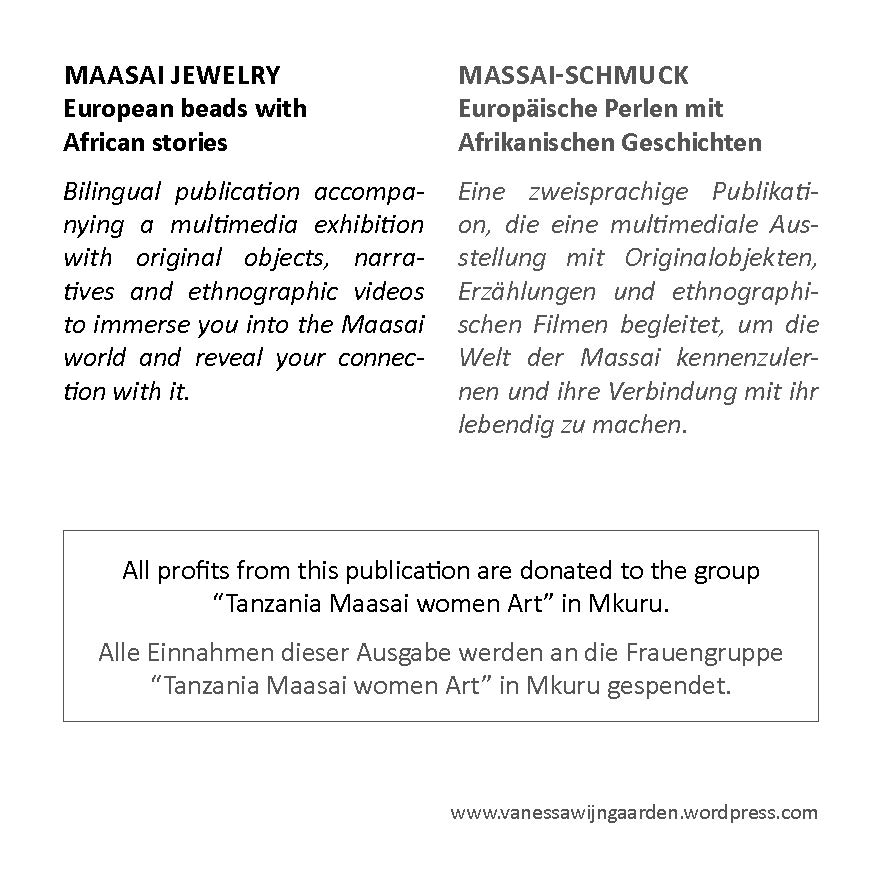
English: ISBN 978-3-00-052327-4, 94 pages, including color photos, original stories and 4 short films.
- Printed book (15 Euro)
- PDF on CD or as a download (7 Euro)
- Available from the publisher Iwalewahaus or to be ordered and paid with Paypal or a banktransfer using the form below.
Deutsch: ISBN 978-3-00-052327-4, 94 Seiten, inklusiv Farbbilder, originale Erzählungen und 4 Kurzfilme.
- Gedrucktes Buch (15 Euro)
- PDF auf CD oder zum Herunterladen (7 Euro)
- Erhältlich vom Herausgeber Iwalewahaus oder mit diesem Formular zum Bestellen und mit Paypal oder Lastschrift zu bezahlen.
Your message has been sent

The Maasai Jewelry multimedia exhibition is a result of academic research and exposes the interrelatedness between Europe and Africa in playful and surprising ways. The mobile exhibition can be booked for for exposition on location. Click here for an impression of previous exhibition spaces.


 Website of Vanessa Wijngaarden